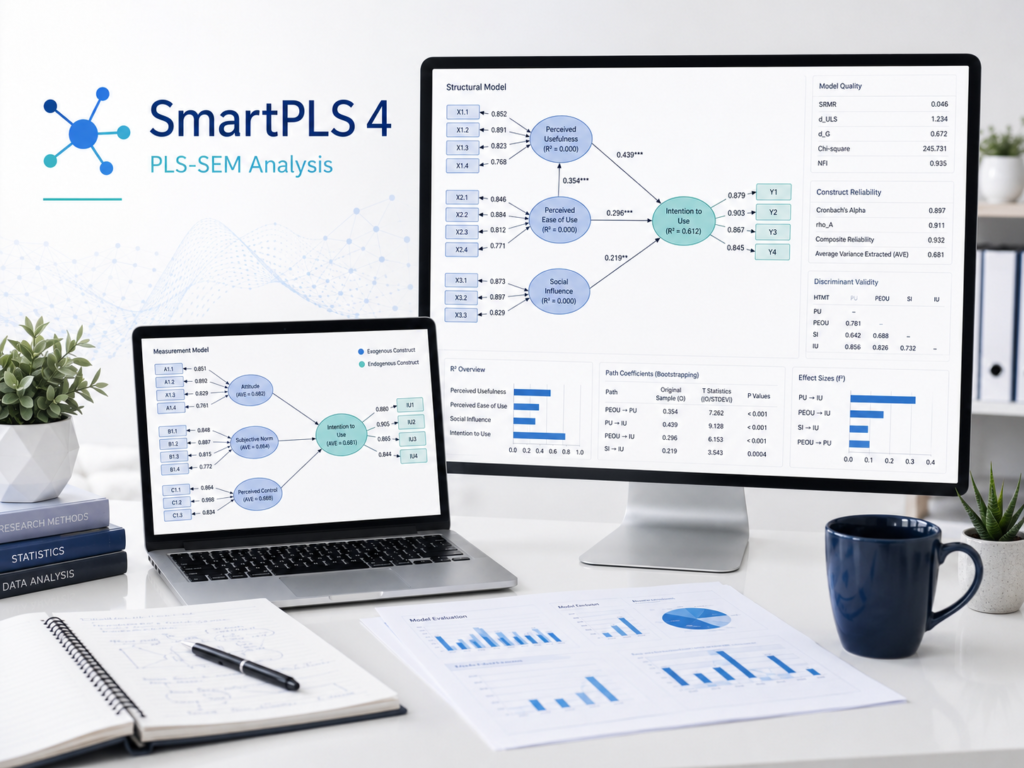
Structural equation modeling is a powerful statistical approach used to examine complex relationships among observed and latent variables. Two major structural equation modeling approaches are Partial Least Squares Structural Equation Modeling (PLS-SEM) and Covariance-Based Structural Equation Modeling (CB-SEM).
At Data Miner Statistics, SmartPLS, PLS-SEM, and CB-SEM analyses are planned according to the research objectives, theoretical model, measurement structure, sample characteristics, data distribution, and hypothesis framework. Each stage of the analysis is carefully conducted, interpreted, and reported in accordance with scientific research standards.
SmartPLS and PLS-SEM Analysis
SmartPLS is widely used for PLS-SEM, especially in studies involving prediction-oriented models, complex structural relationships, formative constructs, mediation, moderation, and relatively small or non-normally distributed samples.
SmartPLS and PLS-SEM analysis services may include:
- Data screening and preparation
- Reflective and formative measurement models
- Indicator reliability assessment
- Internal consistency reliability
- Cronbach’s alpha, rho_A, and composite reliability
- Convergent validity using Average Variance Extracted
- Discriminant validity using HTMT and Fornell–Larcker criteria
- Variance Inflation Factor assessment
- Structural model evaluation
- Path coefficient analysis
- Bootstrapping procedures
- Direct, indirect, and total effect analysis
- Mediation and moderation analysis
- Coefficient of determination assessment
- Effect size analysis
- Predictive relevance evaluation
- PLSpredict analysis
- Importance–Performance Map Analysis
- Multi-group analysis
- Measurement invariance assessment
The results are reported with standardized path coefficients, t-values, p-values, confidence intervals, effect sizes, explanatory power, and predictive performance indicators.
PLS-SEM Measurement Model Evaluation
The measurement model determines whether the constructs are measured reliably and validly. Reflective measurement models are generally evaluated through indicator loadings, Cronbach’s alpha, composite reliability, rho_A, Average Variance Extracted, and discriminant validity criteria.
Formative measurement models require a different evaluation process. Collinearity, indicator weights, indicator significance, and theoretical relevance must be considered carefully. Applying reflective criteria directly to formative constructs may lead to incorrect conclusions.
PLS-SEM Structural Model Evaluation
After measurement-model reliability and validity are established, the structural model is examined. This stage evaluates the hypothesized relationships among latent variables.
The structural model assessment may include:
- Collinearity statistics
- Standardized path coefficients
- Bootstrapping results
- Confidence intervals
- Coefficients of determination
- Effect sizes
- Predictive relevance
- Out-of-sample predictive performance
- Direct and indirect effects
Statistical significance alone is not sufficient. The magnitude, direction, theoretical relevance, explanatory power, and predictive contribution of each relationship must also be interpreted.
CB-SEM Data Analysis
CB-SEM is primarily used for theory testing, theory confirmation, model comparison, and covariance reproduction. It is commonly performed with software such as AMOS, LISREL, Mplus, or R-based structural equation modeling packages.
CB-SEM analysis services may include:
- Confirmatory factor analysis
- Measurement-model testing
- Structural-model testing
- Convergent and discriminant validity
- Composite reliability assessment
- Direct, indirect, and total effects
- Mediation analysis
- Multi-group structural equation modeling
- Measurement invariance testing
- Nested-model comparison
- Model modification and respecification
- Standardized residual assessment
- Model-fit evaluation
Commonly reported fit indices include chi-square, CMIN/DF, CFI, TLI, GFI, AGFI, RMSEA, SRMR, AIC, and other model-comparison statistics. Model fit should be evaluated by considering multiple indices together rather than relying on a single threshold.
PLS-SEM or CB-SEM: Which Method Should Be Used?
The choice between PLS-SEM and CB-SEM should depend on the study objective, theoretical development, model complexity, measurement structure, sample size, distributional characteristics, and prediction requirements.
PLS-SEM may be appropriate when:
- The research is prediction-oriented
- The theoretical model is complex
- The study includes formative constructs
- The sample size is relatively limited
- The data do not satisfy multivariate normality
- Predictive performance is a central objective
CB-SEM may be appropriate when:
- The main objective is theory testing
- The research model is strongly established
- Overall model fit is important
- Competing theoretical models will be compared
- The data satisfy the assumptions of covariance-based modeling
- Measurement invariance and nested-model comparisons are required
The final decision should not be based only on software preference. The selected method must be methodologically consistent with the research question and theoretical framework.
Mediation and Moderation Analysis
SmartPLS, PLS-SEM, and CB-SEM can be used to test mediation and moderation effects. Mediation analysis evaluates whether the influence of an independent variable on an outcome variable operates through an intervening variable.
Moderation analysis examines whether the strength or direction of a relationship changes according to another variable. These analyses may include:
- Simple mediation
- Parallel mediation
- Serial mediation
- Partial and full mediation
- Continuous moderation
- Categorical moderation
- Interaction effects
- Moderated mediation
- Conditional indirect effects
Indirect and interaction effects should be evaluated using bootstrapping confidence intervals and interpreted within the theoretical context of the study.
Accurate Analysis and Publication-Ready Reporting
Structural equation modeling requires more than drawing a path diagram and obtaining software output. The measurement model, reliability, validity, collinearity, model fit, explanatory power, predictive performance, and hypothesis results must be evaluated systematically.
Professional SmartPLS, PLS-SEM, and CB-SEM support may include:
- Selection of the appropriate SEM approach
- Development of the measurement and structural models
- Reliability and validity assessment
- Hypothesis testing
- Mediation and moderation analysis
- Preparation of publication-ready tables
- Scientific interpretation of findings
- Methodology and results-section writing support
- Evaluation of reviewer comments
- Revision of statistical analyses when necessary
At Data Miner Statistics, each structural equation model is examined according to its methodological requirements. The goal is to provide accurate, transparent, scientifically grounded, and publication-ready results.
Contact Data Miner Statistics for professional SmartPLS, PLS-SEM, CB-SEM, mediation, moderation, measurement-model, and structural-model analysis services.